Blog
Chaebols and China: Why Korea's Giants Can't Just Walk Away
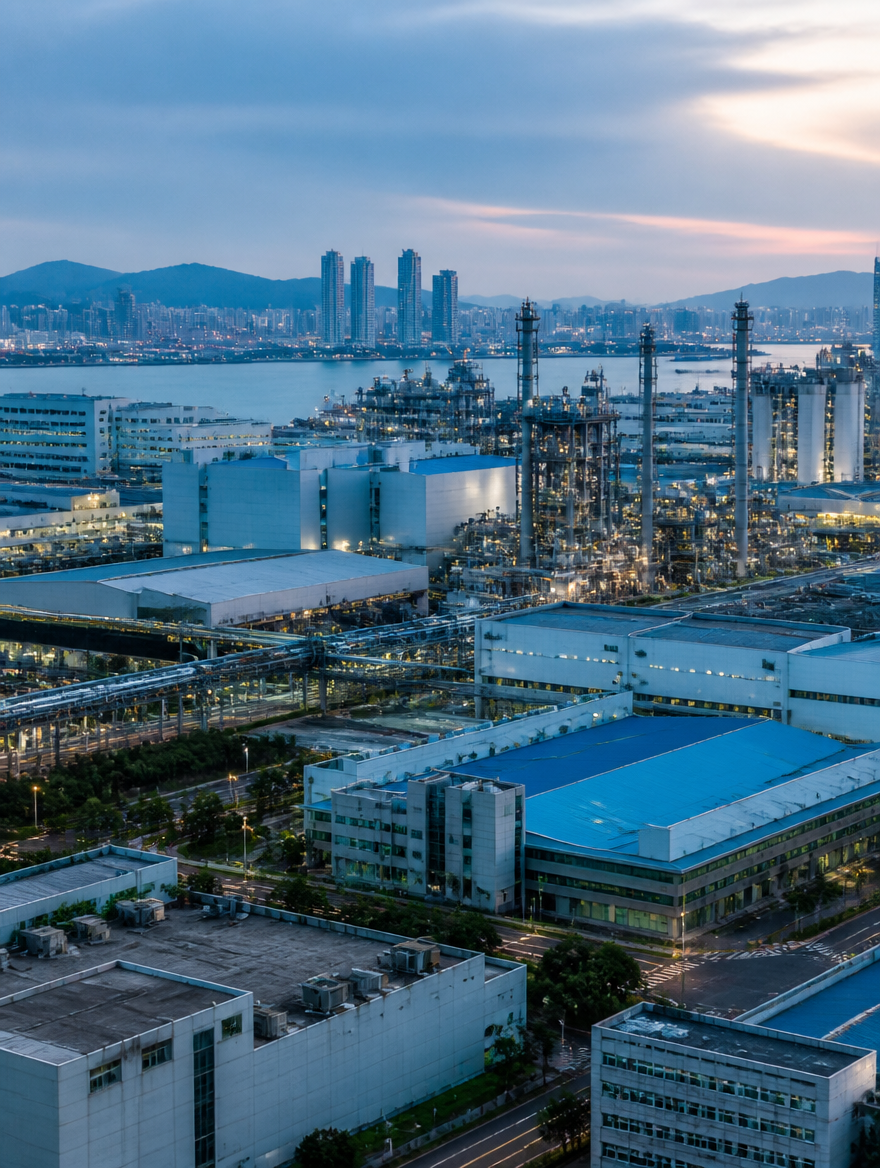
When Beijing briefly restricted gallium and germanium exports in 2023, Samsung and LG's headquarters didn't treat the news as abstract geopolitics — they treated it as a direct threat to production schedules. Despite decades of talk about diversification, South Korea's chaebols remain one of East Asia's economies most dependent on China — the dependency has simply shifted from finished goods to raw materials and intermediate components.
A dependency that doesn't jump out at you
South Korea has historically sourced over 80% of its rare-earth needs through Chinese imports — elements critical for electric-motor magnets, semiconductors, and displays, i.e. the core products of Samsung, LG, and Hyundai. An even clearer example is the battery industry: Samsung SDI and LG Energy Solution, two of the world's largest EV battery makers, continue to source a significant share of synthetic graphite for anodes from Chinese suppliers, despite major investments in their own and North American production capacity over the past several years.
This produces a split picture: at the level of finished batteries and modules, Korean companies are direct competitors to China's CATL and BYD; at the raw-material level for those same batteries, they remain clients of Chinese processors. Diversification is happening, but by its nature it's much slower than headlines about "economic decoupling" suggest — rare-earth processing and battery-grade graphite production require capital-intensive plants with long lead times, not a supplier swap on a phone call.
Why the chaebols aren't rushing to fully exit
The logic of these large conglomerates is fairly rational: fully exiting Chinese supply chains would mean either a sharp cost increase from pricier alternative sources or years of waiting for new processing capacity in Australia, Canada, or Korea itself to come online. Meanwhile the chaebols themselves remain major players in China's consumer and industrial markets — Samsung, Hyundai, and LG have invested in Chinese manufacturing capacity for decades, and a full break would hurt both sides at once.
So the actual strategy looks less like "leaving China" and more like building parallel alternative chains — joint ventures for rare-earth processing outside China, long-term nickel contracts with Australian and Indonesian suppliers, and expanding cathode-material capacity in North America to meet local-content rules. It's a slow, expensive insurance policy, not a quick pivot.
What this means for partners and suppliers
For companies looking to plug into chaebol supply chains — whether supplying raw materials, components, or manufacturing services — the key signal is that the diversification window is genuinely open right now: Korean buyers are actively hunting for alternatives but haven't yet found enough scalable options outside China. That's an opening for new players from Southeast Asia, Australia, and even the Middle East, provided they can meet the strict quality and volume standards Samsung and LG's existing suppliers are used to.
Semiconductors: a separate front of dependency
Beyond batteries and rare earths, there's another layer of dependency that gets discussed less openly: South Korea itself, through Samsung and SK Hynix, remains the world's largest memory chip supplier, and a significant share of that output has historically been assembled and tested at facilities inside China. US export restrictions on semiconductor equipment forced both companies to rethink how their Chinese plants operate, but fully shutting them down would mean writing off billions of dollars invested over the past two decades. As a result, the chaebols find themselves squeezed between American export-control requirements and their own multi-billion-dollar assets on Chinese soil — another example of "decoupling" looking, in practice, like a balancing act rather than a clean break.
Where to watch this develop
The question of chaebol dependency on Chinese raw materials will stay a central topic for anyone watching Asian supply chains in the coming years — it directly shapes the cost of batteries, semiconductors, and consumer electronics worldwide. Anyone who wants a real understanding of how these chains actually function, rather than press-release statements, should add Korean industrial sites to a dedicated tour itinerary and compare them directly against Chinese suppliers of the same raw materials.