Blog
China's Domestic Beauty Brands Are Beating Global Rivals — and Rewriting Retail
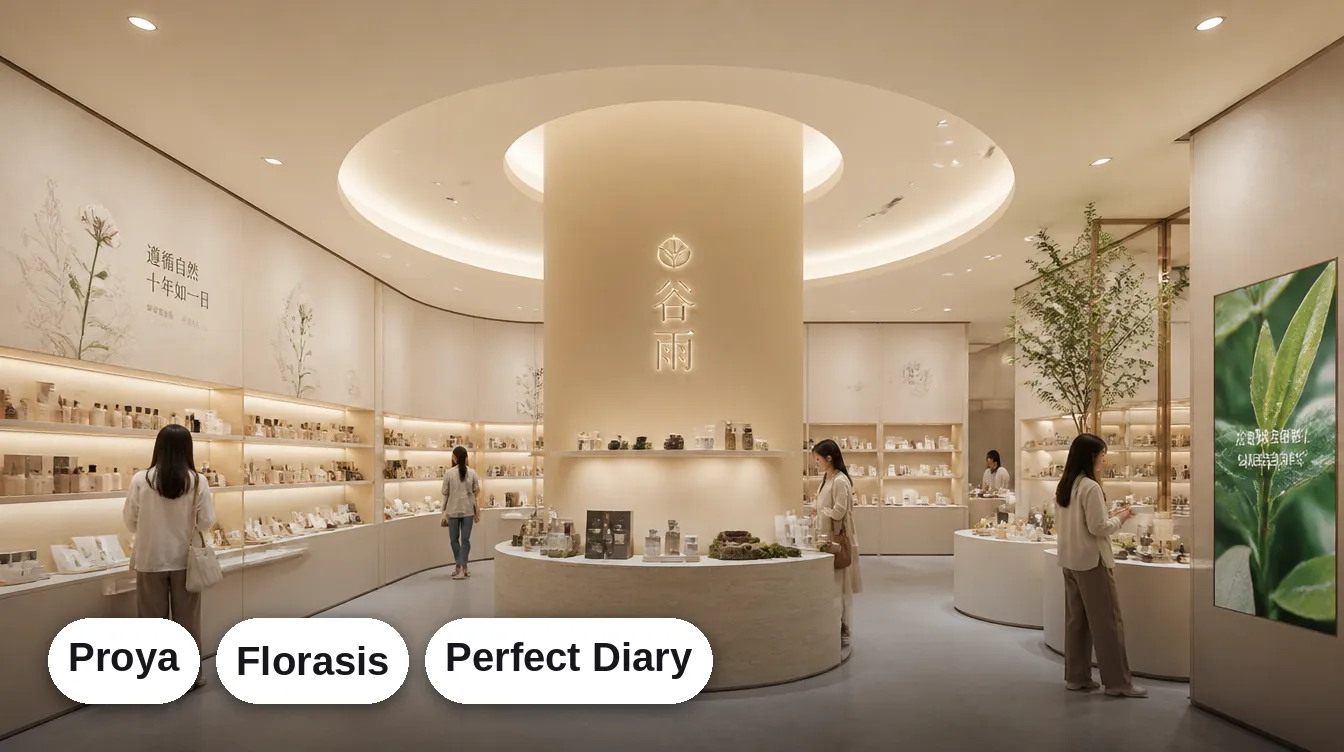
Five years ago, the shelves of flagship beauty stores in Shanghai and Beijing were dominated by L'Oréal, Estée Lauder and Shiseido. The picture looks different now: domestic brands' share of China's cosmetics market hit 57.4% in 2025 — the fourth consecutive year local players have outgrown foreign ones. The market itself isn't stalling either: total sales topped 1.1 trillion yuan (about $159 billion) in 2025, up 2.8% year-on-year.
Proya beat L'Oréal Paris on its own turf
花西子 / Florasis gets plenty of attention, but it's 珀莱雅 / Proya that best symbolizes the power shift. In 2024, Proya became the first Chinese cosmetics company to cross 10 billion yuan in annual revenue. In 2025 it ranked second by cosmetics GMV on Douyin (over 3 billion yuan) and took the #1 spot in Tmall skincare sales — with more than 4 billion yuan in revenue, ahead of L'Oréal Paris in that category. On a market where local brands were recently considered locked out of the top tier, that's a structural shift, not a one-off promotional win.
Florasis moved from mass-market into Paris luxury malls
Florasis took a different route — premium positioning built around traditional Chinese medicine (TCM) aesthetics and ornate floral packaging. In June 2025 the company opened a 6,480 sqm AI-enabled smart factory near Hangzhou to sharpen formula precision and speed up premium product launches. Then in September 2025, Florasis became the first C-beauty brand to open a store inside Samaritaine Paris Pont-Neuf, a luxury mall in Paris. A brand that not long ago read as local mass-market now physically shares a street with houses like Louis Vuitton.
Perfect Diary: from online hype to 200+ physical stores
逸仙电商 / Yatsen — the parent company behind 完美日记 / Perfect Diary, a brand that built its early reputation on explosive online growth — has taken the reverse path: Perfect Diary now runs more than 200 offline stores, with 2025 revenue exceeding 5 billion RMB. Notably, a brand born online found its next growth engine in physical retail.
The store as a cultural hub, not a shelf
What ties the offline strategies of all three brands together is a move away from the classic store format. Points of sale increasingly double as cultural spaces — art installations, themed libraries, mini skincare consultation corners. At the same time, brands are pushing hard into lower-tier cities, where the market isn't saturated yet and competition from foreign players is thinner.
For anyone sourcing or distributing beauty products in Russia, that's two signals at once. First, domestic Chinese brands are now competitive on positioning and quality, not just price — they can no longer be dismissed as "the cheap alternative." Second, the physical retail format in China is evolving faster than in most other markets, and what looks like an experiment today often becomes the standard within a year or two.
On the beauty and anti-age industry expedition you can see these formats in person — from R&D labs to flagship showrooms — and the flagship retail showrooms tour lets you compare how different categories of business solve the same problem: turning a point of sale into a reason to visit, not just a place to buy.