Blog
Who owns China's smart home market: Haier, Midea, and Xiaomi by the numbers
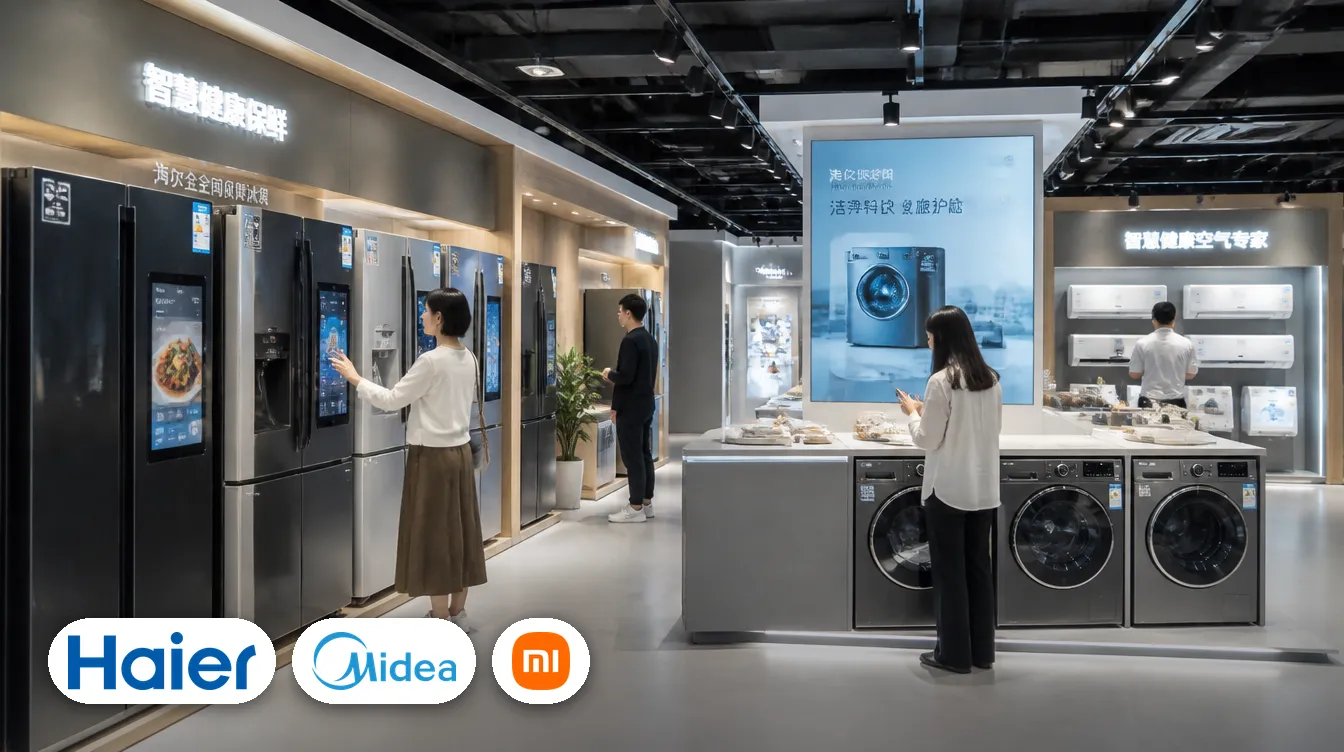
China's home-appliance market is worth $117.22 billion in 2026 and is projected to grow to $143.1 billion by 2031 (a 4.07% CAGR). But behind that number sit three very different strategies from three very different companies — competing less with each other inside China than for who builds the "brain" of the smart home for the rest of the world first.
Haier: the leader not because of China, but because of everywhere else
海尔智家 / Haier Smart Home is the largest player in the global appliance market, holding roughly a 16% share. The key number isn't its China share — it's the overseas one: more than 50.3% of Haier's revenue now comes not from China but from brands it acquired abroad — GE Appliances (US), Candy (Italy), Fisher & Paykel (New Zealand). Through those acquisitions plus its own OEM manufacturing, Haier controls 20-23% of global refrigerator volume — nearly double its nearest competitor. Its "Smart Home Brain" ecosystem ties refrigerators, washers and HVAC units into one managed system rather than standalone appliances.
Midea: not a brand, but a production line for other people's brands
美的集团 / Midea Group takes a different route: overseas revenue is 41.3% of the total, and within that, 43% is already sold under Midea's own brand (OBM) rather than made for someone else's label. The company owns the Toshiba appliance brand and holds roughly 10% of the global branded refrigerator market — on top of a large OEM/ODM business, meaning Midea also manufactures appliances that other companies sell under their own names. Its strategic bet is AIoT platforms that tie devices across categories into one control layer.
Xiaomi: software instead of hardware
小米 / Xiaomi entered the appliance market not through its own factories but through an ecosystem and alliances. As of end-March 2026, 1.1187 billion devices were connected to Xiaomi's AIoT platform — up 18.5% year over year. The number of users with 5 or more connected devices hit a record 23.6 million (+22.3% YoY), while the Xiaomi Home app's monthly active users grew to 117 million. Xiaomi also holds a 1.29% stake in Midea (RMB 1.266 billion, about $203 million) — an alliance where Midea supplies manufacturing muscle and Xiaomi supplies the software platform and consumer-facing brand.
Three different paths, one target
Haier scales by acquiring foreign brands, Midea by vertically integrating manufacturing and running OEM for competitors, Xiaomi by layering a software ecosystem on top of other people's hardware. Seeing all three models in action on one trip — not in a slide deck, but on real production lines and in real showrooms — is exactly what the China's Smart Home & Appliances Expedition route covers, with factory and R&D visits to all three companies.
What sets the Chinese market apart from any other appliance market is that manufacturer, ecosystem and retail often sit under the same group of companies — and that connection is worth seeing in person for anyone evaluating a partnership or a technology purchase for the smart home.