Blog
Gree: The World's Largest Air Conditioner Maker Goes Global
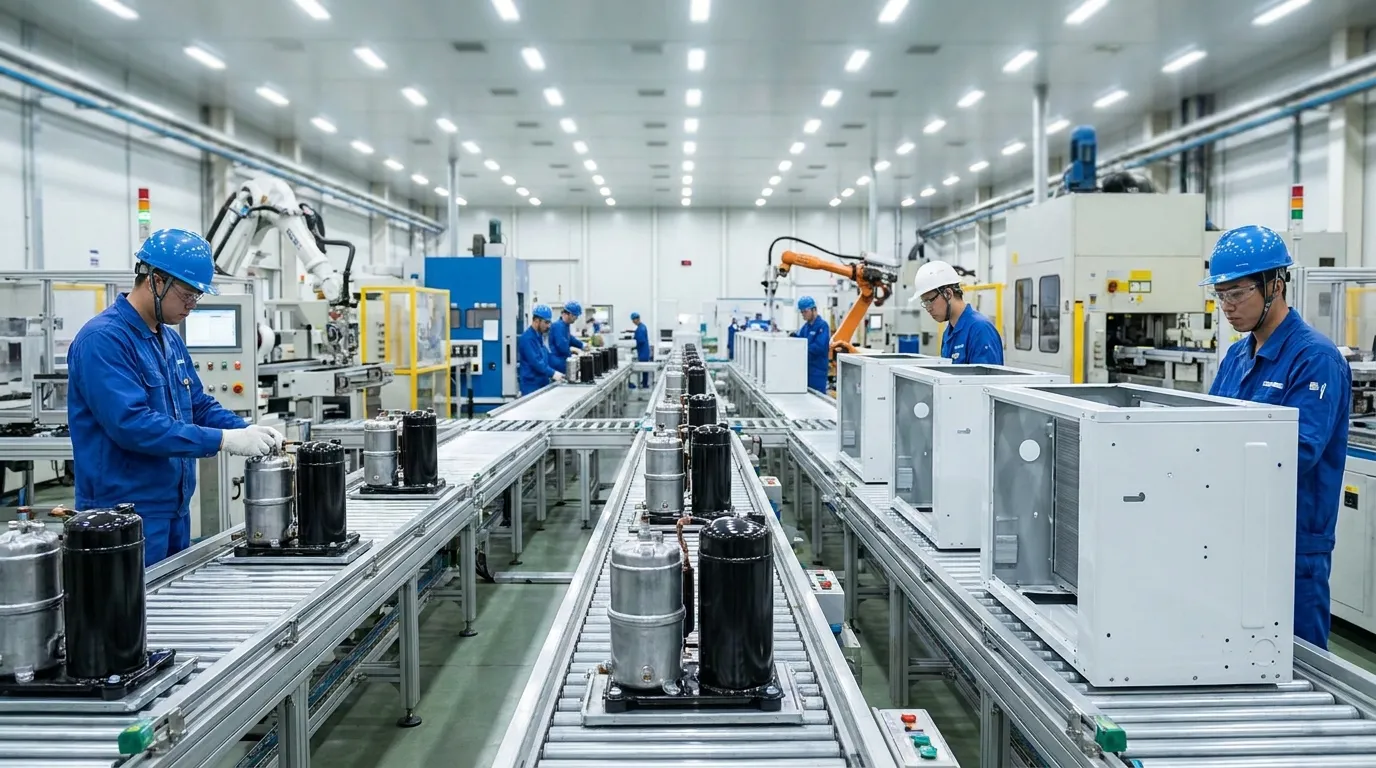
Gree Electric / 格力电器 is the world's largest maker of air conditioners, and after a downturn in 2025 the company started 2026 with a recovery: Q1 revenue rose 3.5% year-on-year to CNY 42.9 billion (about $6.2 billion), while net profit climbed 3% to CNY 6 billion ($878 million). For a company whose air conditioner sales have historically driven the bulk of revenue, even this moderate growth signals stabilization after a tough year.
Why air conditioners remain the core business
Gree's lineup spans everything from wall-mounted household units and multi-split systems for apartments and offices to central air-conditioning systems for large buildings. That vertical integration — from compressors to finished systems — has historically been the source of the company's price advantage domestically. But it's also the risk when domestic demand slows: the diversification into industrial components and high-tech equipment the company describes as its strategy through 2026 is an attempt to reduce dependence on a single product segment.
Betting on four regions
Gree explicitly names four geographies as priorities for medium-term growth: Southeast Asia, the Middle East, Europe and North America. The strategy follows a classic pattern for large Chinese manufacturers — brand recognition first, then local distribution, and only then local production or assembly. This staged approach reduces capital risk compared to building a factory in a new market outright, but it requires more time to establish the brand in buyers' minds outside China. This kind of home-appliance manufacturing playbook can be seen firsthand on the China Appliances Expedition, which examines the production and export models of the sector's biggest players.
A multi-year benchmark
The company is targeting a 5–8% compound annual revenue growth rate through 2026 — a conservative but steady benchmark for an industry that has already passed the peak of extensive growth inside China and is now looking for additional gains from geography rather than volume alone.
What it means for overseas partners
For HVAC distributors, systems integrators and developers outside China, Gree's localization push is essentially an invitation to a deeper form of partnership than simple procurement of finished goods — local assembly implies agreements on joint production lines, staff training and adapting the product to regional climate and energy standards, not just to a price segment of the market.
Energy efficiency as the new export language
In developed markets across Europe and North America, an air conditioner's competitiveness is defined not just by price but by its energy-efficiency class, compliance with local refrigerant standards, and compatibility with smart energy grids. Gree has historically competed primarily on price in developing markets, but to establish itself in Europe and North America the company will increasingly need to sell engineering characteristics — energy efficiency ratio, noise levels, refrigerant environmental impact — rather than affordable installation cost alone. That's a fundamentally different type of sale, requiring different certification channels and a different conversation with B2B buyers, whether developers or systems integrators.
Diversification as insurance against cyclical demand
Air conditioner demand is heavily tied to weather and construction cycles — a cool summer or a construction slowdown drags sales down regardless of product quality. Gree's investments in industrial components and high-tech equipment are an attempt to smooth out that cyclicality through less seasonal business lines, where demand is shaped by industrial cycles rather than a particular summer's weather.
Dividend policy as a signal to investors
Alongside its quarterly results, the company announced a dividend plan worth roughly $1.6 billion — a fairly bold move against a backdrop of profit decline a year earlier. The market reads this as a signal of management's confidence in the business's resilience, even when short-term revenue figures aren't spectacular: generous dividends discourage institutional investors from selling during weaker quarters and underline that the company is still generating enough free cash flow to fund overseas expansion and shareholder payouts at the same time.
Sources
Q1 2026 financial figures are drawn from Yicai Global and industry coverage on ad-hoc-news.de.