Blog
Pop Mart: How Collectible Toys from Beijing Took Over Malls Worldwide
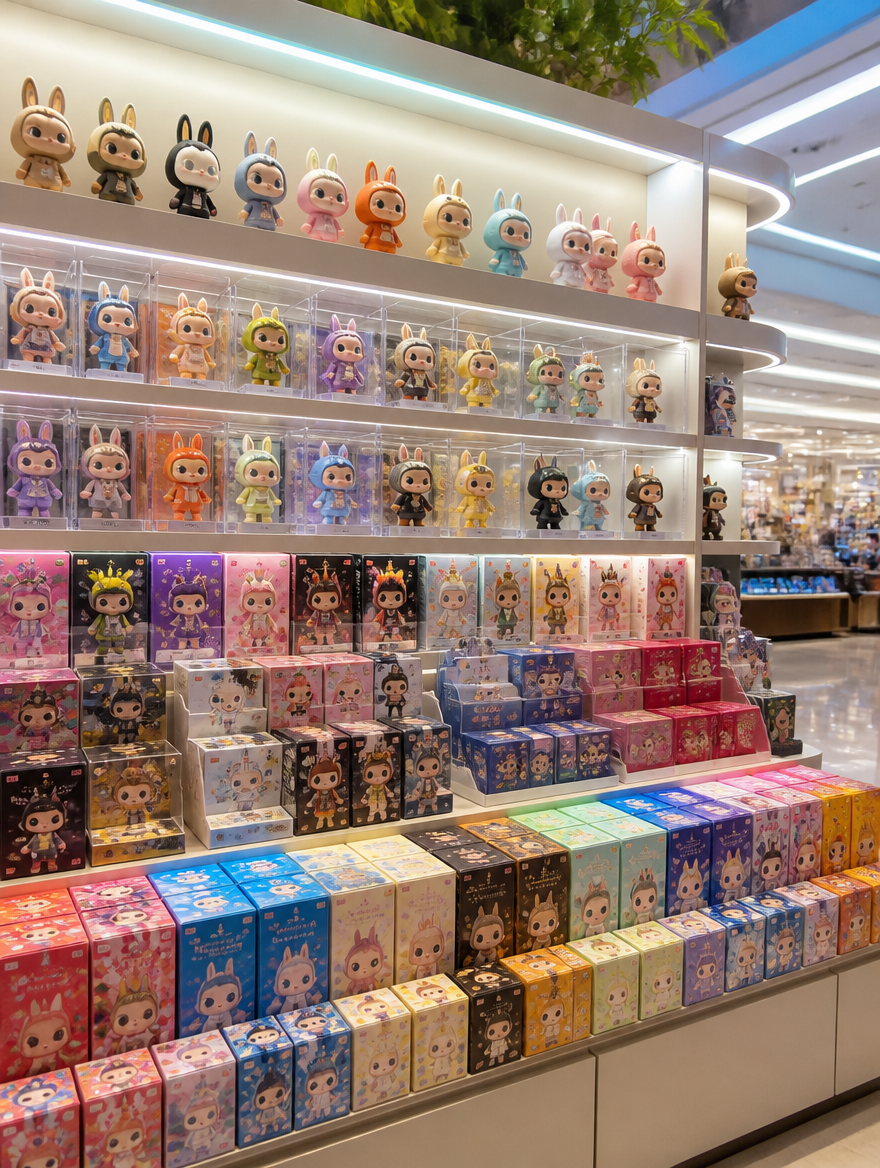
Five years ago, "blind box" meant nothing to a Western shopper. Today a queue in front of a wall of Labubu figures at Selfridges in London or Dubai Mall in the UAE is an ordinary sight, and 泡泡玛特 / Pop Mart has gone from a niche Beijing retailer to a genuine global pop-culture brand.
Numbers that surprised even the analysts
For the first half of 2025, Pop Mart reported revenue of roughly RMB 13.9 billion — more than triple the prior year. The bigger shift: for the first time in company history, sales outside mainland China (about RMB 9.7 billion, up over 400% year-on-year) overtook domestic revenue. That's not a cosmetic detail — it's a business-model pivot. A company that as recently as 2022 was seen as a purely domestic Chinese growth story is now, unmistakably, a global expansion story.
The secret isn't just Labubu — that character is a catalyst, not the only product. Pop Mart runs more than two dozen IPs, including Molly, Skullpanda and Dimoo, and rotates lineups systematically so the business doesn't depend on a single hype cycle.
Retail engineered for scarcity
The format hasn't changed: opaque packaging, an element of chance and collecting, Roboshop vending machines sitting alongside full-format stores. By mid-2025 the company had more than 2,000 points of sale and machines in China and over 130 stores abroad — from Southeast Asia to the US and Europe. It's retail density in airports, premium malls and tourist hotspots that creates the "grab it before it's gone" effect no advertising campaign can replicate.
Asia as the proving ground before the West
For anyone studying the Pop Mart model, one thing matters: before storming London and New York, the brand spent years refining its unit economics in Thailand, Singapore, Malaysia and South Korea — markets with comparable shopping culture and mall density. That's where pop-up formats, mall partnerships and regional-holiday localization were all tested first.
What it means for the designer-toy market
Pop Mart's success has triggered a wave of imitators — from Korean labels to local Thai and Vietnamese startups trying to copy the "collectible figure plus lottery mechanic" format. But replicating the company's retail discipline — scarcity management, the pace of collection drops, the secondary resale market for figures — has proven much harder than copying the packaging.
For buyers and entrepreneurs studying China's consumer market, Pop Mart is a clean illustration of how a local trend becomes a global category within three or four years, provided a company controls design, manufacturing and retail all at once.
The hype logistics: how the company manages scarcity physically
Behind the scenes, Pop Mart runs a fairly sophisticated production and logistics machine. Figures are cast at contract factories in the Pearl River Delta, where the company tightly controls molds and color standards — which is exactly why counterfeits on the resale market are visually identifiable even to a non-specialist. From there, finished stock moves to regional distribution centers and ships out to stores worldwide in sync on drop day, so there's no gap between "already on sale in Beijing" and "not yet available in Bangkok" — a gap that, in the social-media era, instantly turns into gray-market imports and reseller markups.
Risks the model doesn't advertise
Investors and partners should keep the vulnerabilities in mind too: the company depends heavily on its ability to keep launching new popular IPs, and fashion around any given character is unpredictable and can cool as fast as it caught fire. Rapid international growth also adds operational load — opening a store in a new jurisdiction requires local logistics, hiring and assortment adaptation, and not every expansion pays back at the same speed.
Anyone who wants to see this model up close — from the factories casting vinyl figures to the showrooms where new IPs get tested — should consider business tours in China, where these supply chains can be examined on-site rather than read about in press releases.
Pop Mart's trajectory also shows the limits of hyper-growth: rapid expansion invites demand overheating and secondary-market speculation, and reliance on one or two hit IPs is always vulnerable to shifting taste. Still, the company has already proven the main point — a designer toy out of China can be a genuine global category leader, not a local curiosity.