Blog
From Nickel Ore to Battery Cell: Chinese Money Is Building Indonesia's Battery Chain
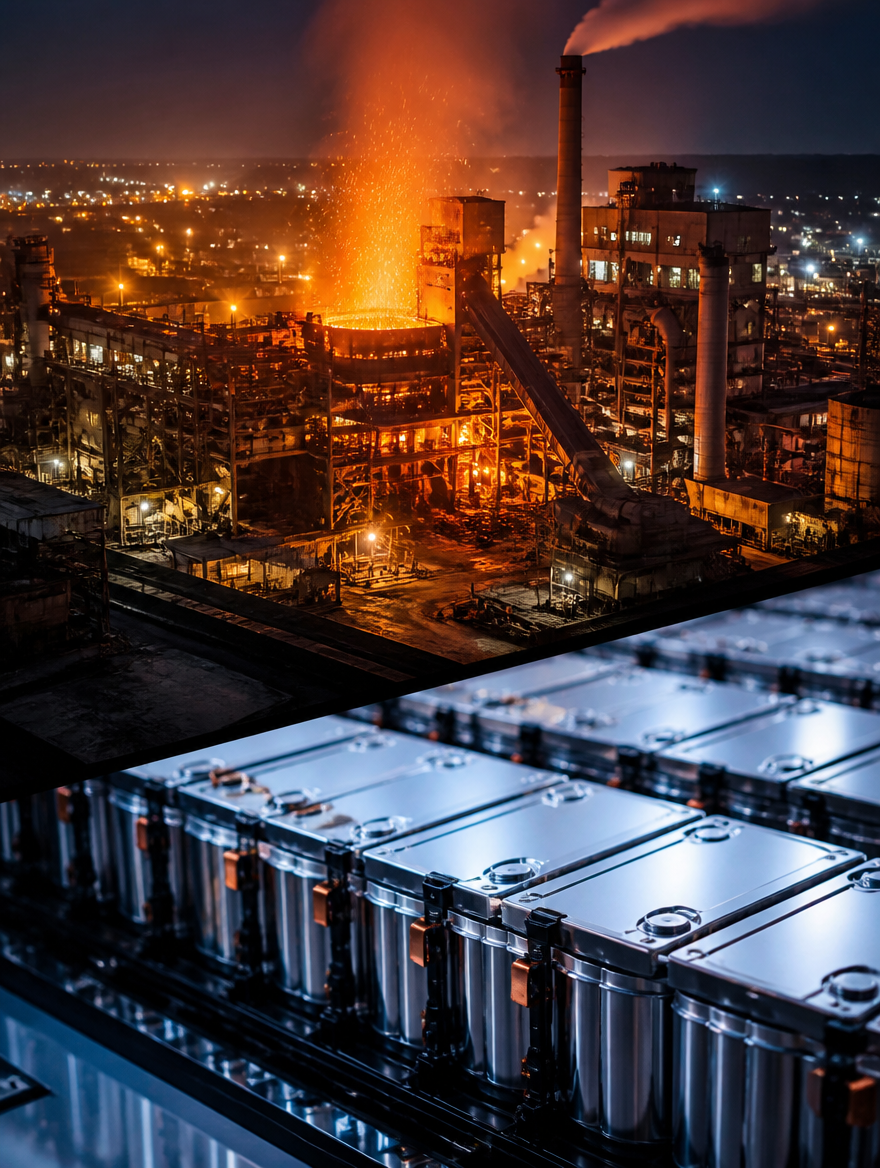
If the global battery industry had one raw-material supplier everything else depended on, it would be Indonesia. Geological surveys put the country's share of proven global nickel reserves above 40%, and it accounts for more than half of world nickel ore output — and it's around this raw material that Jakarta has built one of the most ambitious industrial policies of the past decade.
An ore export ban as an industrialization lever
In 2020, Indonesia banned the export of unprocessed nickel ore outright, forcing foreign buyers — chiefly Chinese steel and battery companies — to relocate smelting and processing capacity directly into the country. The move drew a WTO complaint from the EU, but it worked in practice: within a few years, dozens of smelters sprang up in the Morowali (Sulawesi) and Weda Bay (North Maluku) industrial parks, most of them financed and built by Chinese groups — Tsingshan, Huayou Cobalt, GEM.
From pig iron to battery precursors
The first wave of investment built plants for ferronickel and nickel pig iron (NPI) — feedstock for stainless steel. The second wave, which picked up from 2021–2022, involves HPAL (high-pressure acid leaching) plants capable of producing battery-grade nickel. 宁德时代 / CATL — the world's largest battery maker — plays a central role here, having announced, together with Indonesia's state mining group and partners, a consortium project with investment estimated in the billions of dollars, spanning mining, processing, precursor materials and battery cell production.
The environmental cost of industrialization
The model has a downside that can't go unmentioned: smelters in Morowali and North Maluku mostly run on coal power, drawing criticism from environmental groups and raising questions from battery buyers concerned about supply-chain carbon footprint. The Indonesian government and investors are responding with plans to shift part of the industrial parks' power supply to gas and renewables, but the transition is moving slower than production capacity is growing.
What this changes for the global EV market
Before Indonesia's pivot, the main nickel hubs feeding the battery industry were Russia, Canada and the Philippines (mostly for NPI). Today a significant share of the world's growth in battery-grade nickel comes from Indonesia specifically, meaning pricing and logistics control over this raw material is steadily shifting to Southeast Asia. For automakers and battery companies looking to diversify raw-material sourcing, Indonesia is no longer a backup option — it's one of the primary ones.
Opportunities for international business
Beyond the smelters themselves, a whole service economy is forming around the industrial parks: logistics, engineering, equipment supply, ESG certification. For companies from third countries, this is a niche where direct competition with the Chinese investors themselves is limited — they're more often looking for contractors and adjacent-service suppliers than mining rivals.
The scale of production, in numbers
Industry estimates put Indonesian nickel ore production at over 1.8 million tonnes of contained metal a year — more than the next several producer countries combined, including the Philippines and New Caledonia. That concentration of output in a single jurisdiction makes the global battery industry structurally dependent on regulatory stability in Indonesia specifically.
**Royalties, local content and the ongoing negotiation with Jakarta.**
Indonesia's government keeps revising the rules of the game: nickel-mining royalty rates, local-ownership requirements (a mandatory share of Indonesian capital in projects), export duties on intermediate processed products. For investors that means regulatory risk has to be baked into the business model from day one — terms in place when an agreement is signed can change before a project reaches full capacity, as has already happened with several projects in the sector.
**Indonesia is aiming higher up the chain.**
Beyond raw materials, the country is increasingly trying to localize final battery-cell assembly and even EV assembly itself — aiming to become not just a nickel supplier but a full link in producing finished EVs for regional markets. The success of that strategy isn't guaranteed yet: battery-cell assembly requires far more complex technological capability than ore smelting, and Indonesia is only beginning to build partnerships with Chinese and Korean battery manufacturers on that front.
The Morowali and Weda Bay industrial parks aren't open to casual visitors, but they can be seen as part of organized industrial tours of Indonesia, which include site access and meetings with local operators.