Blog
Midea + Kuka: How an Air-Conditioner Maker Became a Global Industrial Robotics Player
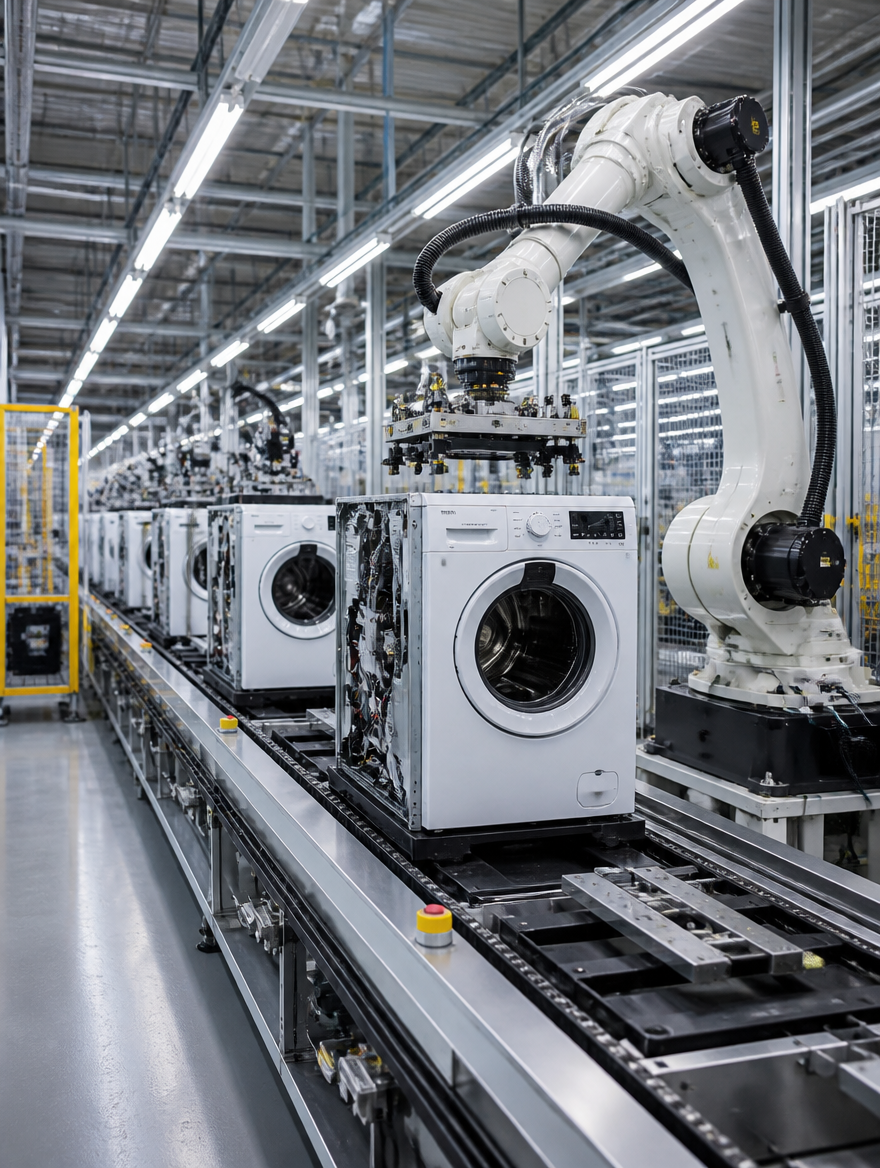
In 2016, the deal looked almost absurd: a Chinese maker of air conditioners and washing machines, 美的集团 / Midea, offering nearly €5 billion for a Bavarian industrial robot maker, Kuka — a company whose robotic arms sit on BMW and Airbus assembly lines. Germany considered blocking the deal on technology-sovereignty grounds. It was approved anyway, and nearly a decade later it looks like one of Chinese industry's most successful bets on technology transfer.
Why an appliance maker needed a robot company
Midea is far more than air conditioners — it's a diversified industrial conglomerate with revenue of roughly RMB 409 billion for 2024, spanning home appliances, compressors, climate equipment and logistics. The logic behind buying Kuka was simple: Midea's own plants produce hundreds of millions of appliance units a year, and automating assembly lines is a direct route to lower costs and higher precision. Rather than buying robots from third-party vendors, the company decided to own the technology itself.
Delisting and full integration
In 2022, Kuka was fully delisted from the Frankfurt Stock Exchange after Midea pushed its stake to nearly 100%. Formally, Kuka's headquarters stayed in Augsburg and its engineering culture and brand were preserved, but strategic control and capital are now entirely Chinese. This "buy the technology, keep the brand and the engineering team" model has become a template for other Chinese industrial M&A deals in Europe.
China's robot market is growing faster than Europe's
After the acquisition, Kuka noticeably expanded its footprint in China: local robot production at plants in Shanghai, product lines adapted for Chinese automakers and electronics manufacturers. Midea, in turn, integrated Kuka's robots into its own production sites — from compressor assembly to logistics warehouses, where robotic arms and automated carts replace manual labor on repetitive tasks.
Why it matters beyond China
The Midea–Kuka model illustrates an alternative path to building robotics capability — not organic R&D from scratch, but acquiring mature Western technology followed by large-scale localization of both manufacturing and the sales market. For companies looking at automating their own production in Asia, the case is instructive precisely because it shows "Chinese robotics" today isn't only local startups like Unitree or Fourier — it also includes fully integrated former European brands with a complete engineering cycle.
What's worth seeing on the ground
For delegations studying manufacturing automation, both sides of the story are worth seeing: Midea's own robotic lines (air conditioners, compressors, appliances) and how the former Kuka's engineering units in China adapt industrial robots to local production standards.
Midea's own scale as context for the deal
To appreciate the scale of the Kuka acquisition, it helps to remember Midea's own size: the company is one of the world's largest home-appliance manufacturers, shipping air conditioners, refrigerators, washing machines and small appliances under several brands to more than 200 countries. That volume of production is exactly what created enough internal demand for industrial robots to justify a nearly five-billion-euro deal.
**Competitors in the same shop floor: ABB, Fanuc, Yaskawa.**
Kuka operates in a market dominated by the so-called "big four" of industrial robotics — ABB, Fanuc, Yaskawa and Kuka itself. After the Midea deal, the balance of power in that market shifted noticeably: Kuka gained a guaranteed captive customer in the form of dozens of Midea plants worldwide, providing stable production volume even during periods when external demand for industrial robots dips due to macroeconomic cycles. For competitors, that's a tangible structural advantage that's hard to replicate without a large industrial customer of one's own.
**What the case shows about China's industrial strategy.**
The Midea–Kuka story isn't an isolated incident — it's part of a broader pattern: Chinese industrial conglomerates systematically acquiring mature Western technology assets in machine tools, robotics and precision engineering, then scaling them across their own manufacturing base and China's domestic market. For anyone watching China's industrial policy, it's one of the clearest examples of technology transfer happening not through industrial espionage but through entirely legal capital-market mechanisms.
Midea's plants and its joint R&D centers with Kuka in China are part of the routes covered by industrial business tours, which let you see automated lines in person rather than in a promotional video.