Blog
Mixue: nearly 60,000 stores and a model you can't copy without the franchise
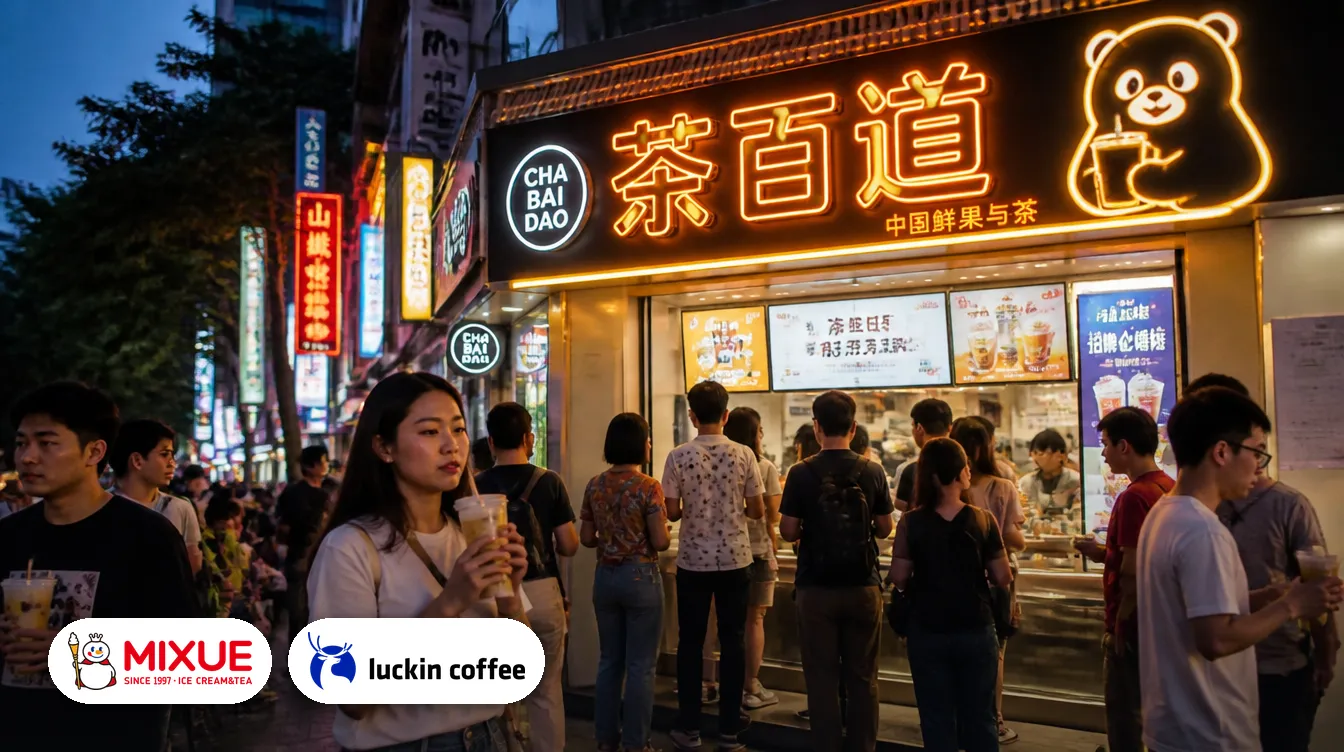
Mixue (蜜雪冰城) ended 2025 with 59,823 stores worldwide — up 28.71% year over year, a net addition of more than 13,000 stores in a single year, roughly 37 new stores a day. For comparison, the chain added a net of about 4,900 stores in 2024 — the growth rate isn't just high, it has accelerated for three years running.
A scale that's hard to grasp from one number
Of the 59,823 stores, 55,356 are in mainland China (present in every county-level city), and 4,467 are overseas across 13 countries. The mainland count alone exceeds McDonald's, Starbucks, Subway, or KFC individually in the same market — while selling tea or ice cream for under a dollar a cup. The model was never built to make its margin on a single drink; it runs on network volume and turnover.
The IPO, and the numbers that explain why the model works
Mixue Group listed on the Hong Kong Stock Exchange on March 3, 2025. For full-year 2025, group revenue reached CNY 33.56 billion (+35.2% YoY), gross profit CNY 10.45 billion (+29.7%), and net profit CNY 5.93 billion (+27.0%). The key detail: Mixue makes most of its money not from the end customer, but from its franchisees — the group sells raw materials, equipment, and logistics to its own franchised stores rather than taking a margin on every cup sold. That's why the end-customer price can stay nearly flat for years while company profit keeps growing faster than revenue.
Luckin Coffee: same market, a different strategy
Luckin Coffee (瑞幸咖啡) is taking a genuinely different path — less about raw store count (36,310 by the end of Q2 2026, split between 23,734 self-operated and 12,576 partnership stores) and more about the pace of financial growth: Q2 2026 revenue of CNY 15.89 billion (+28.5% YoY), Q1 2026 revenue of CNY 11.99 billion (+35.3%), and a record average of 112.7 million monthly transacting customers (+22.9%). In February 2026, Luckin opened its first premium location — the Luckin Coffee Origin Flagship in Shenzhen, sourcing beans from Brazil, Ethiopia, and China's Yunnan province at prices well above its usual menu — a direct move onto ground long defined in China by Starbucks' own Reserve stores.
The same problem, two different answers
Mixue and Luckin are solving the same problem — how to grow in China's brutally competitive drinks market — in opposite directions. Mixue scales its franchise network wide and keeps prices flat where most of its audience actually lives. Luckin, having already overtaken Starbucks on store count in China years ago, is now trying to grow upward on price, not just outward on volume. For anyone watching Chinese retail from the outside, these are two scaling models working at the same time in the same market — not a single correct playbook.
What you see on the ground
The China's New Tea & Coffee Retail Expedition visits nine leaders of this market across four cities, from headquarters to public flagship stores — the difference between Mixue's franchise model and Luckin's premium bet shows up not in a financial report, but in how a specific store is laid out and how long the line in front of it is.