Blog
China's instant-retail price war: how Meituan, Alibaba, and JD.com are burning billions of yuan over a 60-minute delivery window
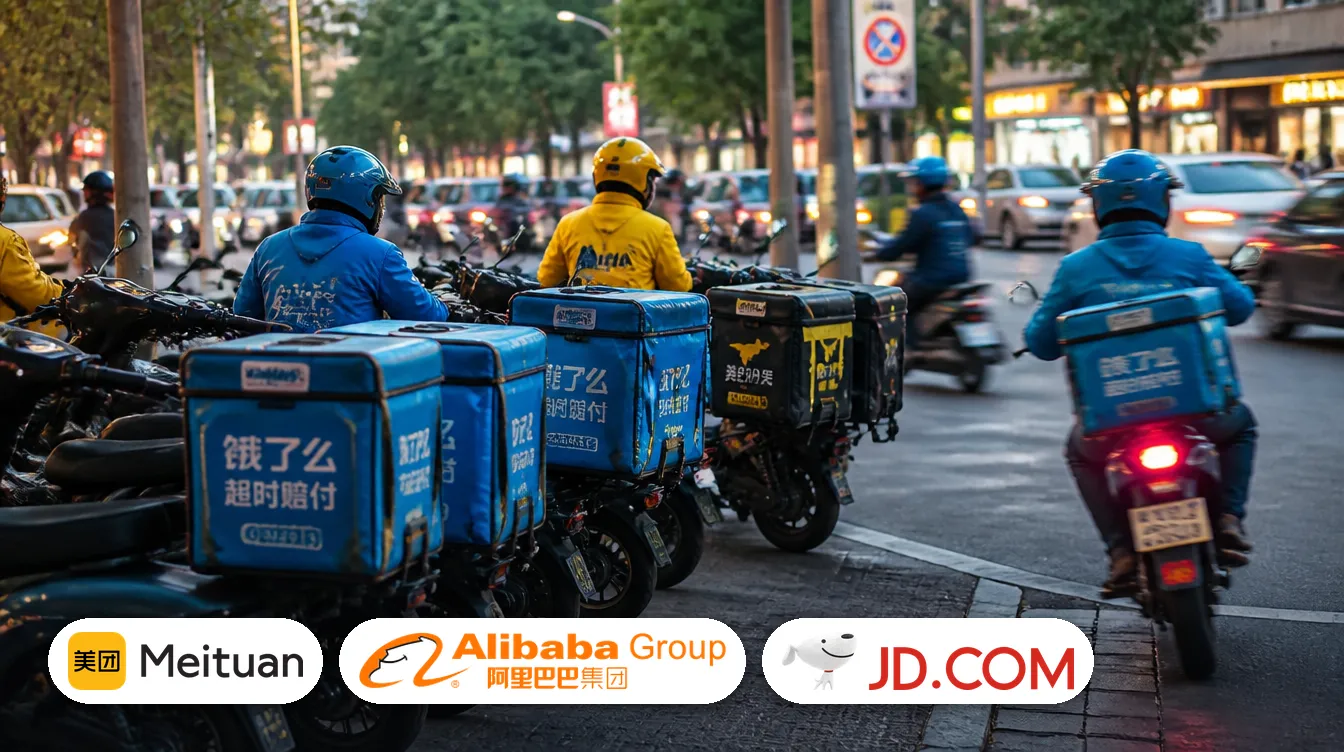
Beijing, Shanghai, Hangzhou — three years ago, instant retail in China was a niche: groceries and noodles in 30 minutes. In 2025 it became a battlefield, and 美团 / Meituan, the market's largest player, closed the year in the red for the first time in years.
Who lost how much
Meituan reported a net loss of 23.4 billion yuan (≈$3.4 billion) for 2025 — even as revenue grew 8.1% to 364.9 billion yuan. This wasn't a sales problem: the company's core local-commerce segment (food delivery and instant retail) swung from a 52.4 billion yuan profit in 2024 to a 6.9 billion yuan loss in 2025. Revenue growth didn't save the margin — the price war ate it.
Where the war came from
The trigger was 阿里巴巴 / Alibaba. In July 2025, the company announced a 50 billion yuan subsidy for Taobao Shangou (淘宝闪购), its instant-delivery platform formed by merging 饿了么 / Ele.me into Taobao. The intent was explicit: pull instant-delivery orders away from Meituan through discounting.
京东 / JD.com didn't stay on the sidelines: in February 2025 the company formally entered food delivery, then launched its own 100 billion yuan subsidy campaign in April. By summer 2025, all three ecosystems — Meituan, Alibaba, and JD.com — were openly fighting over the same order.
What the consumer sees — and what they don't
On the surface, the war looks like a gift: per CNBC, by summer 2025 some promotional cups of coffee were priced at a few dozen cents — a price unthinkable without massive platform subsidies. But behind every discount is a transfer: someone pays for that cup — either the platform out of its own margin, or eventually the merchant through commissions and discounting requirements.
Where the market is headed
According to the China Quick Commerce Databook Report 2026, China's instant-retail market will grow to $126.74 billion by 2029, with sub-60-minute delivery becoming the standard for Tier 1 retail. The GMV split between Meituan and Alibaba had long held around 6:4 in Meituan's favor — but from May to September 2025, Alibaba grew its daily order volume to a level comparable with Meituan's. This isn't an experiment by individual platforms anymore — it's new retail infrastructure being built simultaneously, and at each company's own expense, by all three.
The scale is already visible on the ground: by various estimates, Meituan's network of "flash" dark stores (Meituan Flash Warehouse) had passed 30,000 locations nationwide by 2026, with projections putting it past 100,000 by 2027 — small, hundred-square-meter warehouses within walking distance of residential blocks, not the distribution centers on a city's outskirts we're used to.
What it means for anyone doing business with China
For anyone sourcing from or studying Chinese retail, this war isn't an abstract headline — it's a direct signal: last-mile logistics, dark stores, and warehouse automation in China are developing at a speed unreachable through organic growth alone. The difference between Meituan's infrastructure and Alibaba's isn't cosmetic — it's about whose model survives the next subsidy round. Seeing it in person, rather than in a report, is exactly what our flagship retail and instant-delivery expedition is built for — the route already includes visits to both companies' headquarters, plus JD.com, 拼多多 / Pinduoduo, and Ele.me.