Blog
The Race for the Gulf: How Chinese Auto Brands Are Splitting Up the UAE's EV Market
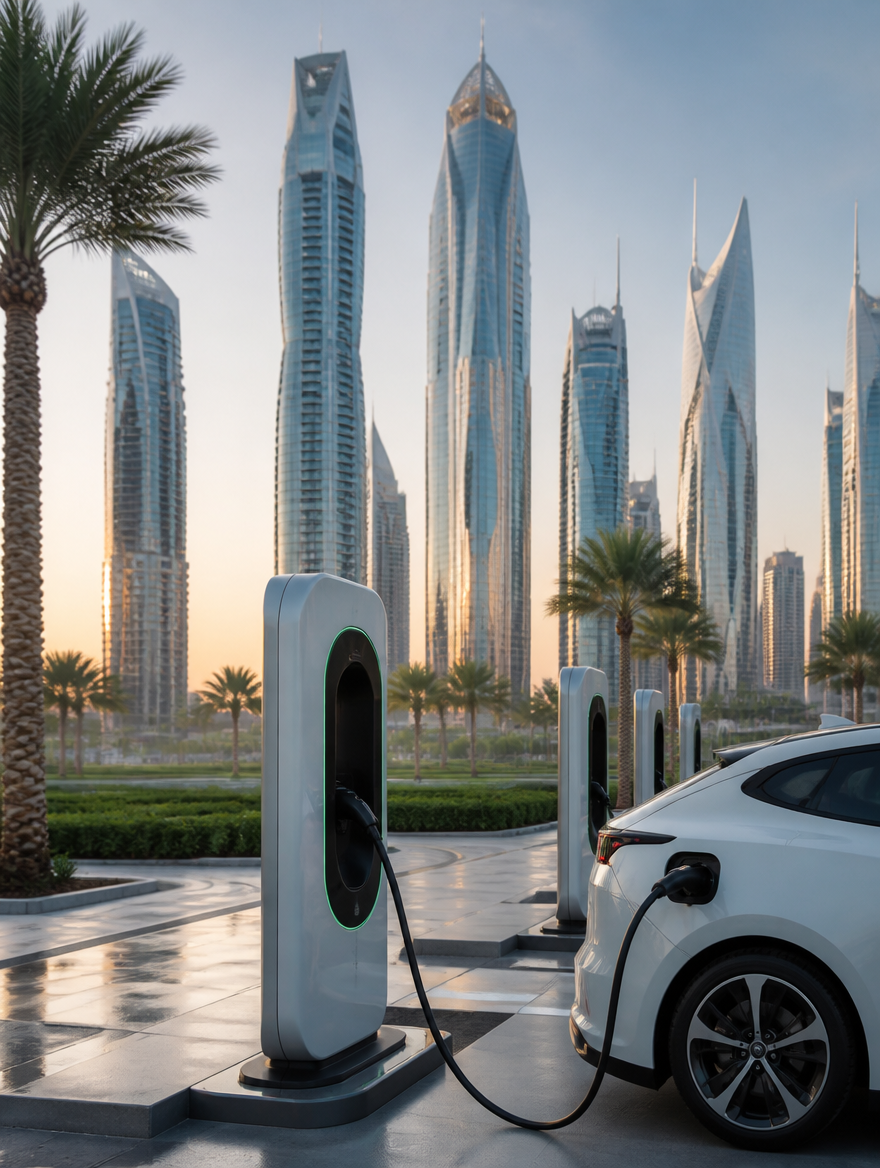
A few years ago, Chinese brands were barely visible in the traffic flow along Sheikh Zayed Road. Today MG, BYD, Geely, Chery and GAC are an ordinary part of Dubai's road mix, and in some months MG has actually become the best-selling brand in the UAE by registrations, ahead of Toyota and Nissan.
MG as the scout, BYD as the main thrust
MG Motor (owned by SAIC Motor) entered the region earlier than most and built a dealer network aimed squarely at the mass-market segment — compact crossovers and sedans priced noticeably below Japanese and Korean equivalents. 比亚迪 / BYD arrived later but with more premium positioning and a lineup made entirely of EVs and hybrids, from the compact Atto 3 up to the luxury Yangwang range. This two-layer push — an affordable mass brand plus a tech-forward EV brand — makes life noticeably harder for legacy players trying to defend both segments at once.
Infrastructure isn't keeping pace with sales
Dubai and Abu Dhabi authorities have announced expansions to their charging networks (notably through DEWA's EV Green Charger program), but the number of public chargers is growing slower than EV sales. That creates a very concrete business niche: private charging-hub operators, companies installing chargers in residential complexes and mall car parks, and battery-servicing operations — a market with no clear monopolist yet.
Why the Gulf isn't just a sales market
For Chinese automakers, the UAE matters for more than sales in a country of roughly 10 million people. Dubai has long served as a regional showcase and re-export hub for cars that then fan out to markets across North Africa, the Levant and Central Asia — much the way consumer goods flow through Jebel Ali. Showing a model at GITEX or the Dubai Motor Show effectively presents it to several regional markets at once.
No subsidies as a market feature
Unlike China or Europe, the UAE has almost no direct government subsidies for private EV purchases — competition happens on pure price and product, without artificial demand support. That's precisely why Chinese brands, whose production costs run lower thanks to vertical integration (BYD's own battery manufacturing, for instance), gain a structural edge over competitors forced to import components.
What it means beyond automakers themselves
A growing EV fleet drags adjacent industries along with it: EV-specific insurance, a secondary battery market, service centers with technicians certified specifically on Chinese brands — expertise the market genuinely lacks enough of right now. For investors and dealers eyeing the Gulf, the timing is favorable: the market is growing faster than the surrounding service infrastructure can form around it.
The price gap that decides everything
The key factor behind Chinese brands' success in the Gulf is price: comparable-class MG or BYD models are often 15–25% cheaper than Toyota, Hyundai or Volkswagen equivalents, with similar or richer equipment levels. In a market where buyers often replace a car every three or four years rather than keeping it for a decade, that price gap turns out to be a more decisive argument than brand or reputation more often than not.
**The dealer model: why local partners matter so much.**
Unlike China, where automakers can open their own showrooms directly, the UAE has a long tradition of powerful local distributor groups — large family conglomerates that have held exclusive rights to sell Japanese and European brands for decades. Chinese companies entering the market either have to plug into that system through partnerships with existing dealer groups or build their own network from scratch, and most choose the former, because local distributors' reputations and ties to banks and insurers are critical for after-sales service.
**Resale value — the next trust barrier.**
One of the biggest questions for a Gulf buyer is what a car will be worth on the secondary market in three or four years. Japanese and German brands have decades of track record here; Chinese EVs don't yet have enough sales history to give buyers confidence about resale value. That's exactly why many Chinese brands in the region are experimenting with extended warranties and buy-back programs — a way to compensate for the missing historical data.
Studying dealer networks, showrooms and import logistics on the ground is possible through business tours in the UAE, which include meetings with local distributors of Chinese auto brands.