Blog
Jebel Ali: How the Middle East's Biggest Port Became China's Re-Export Gateway
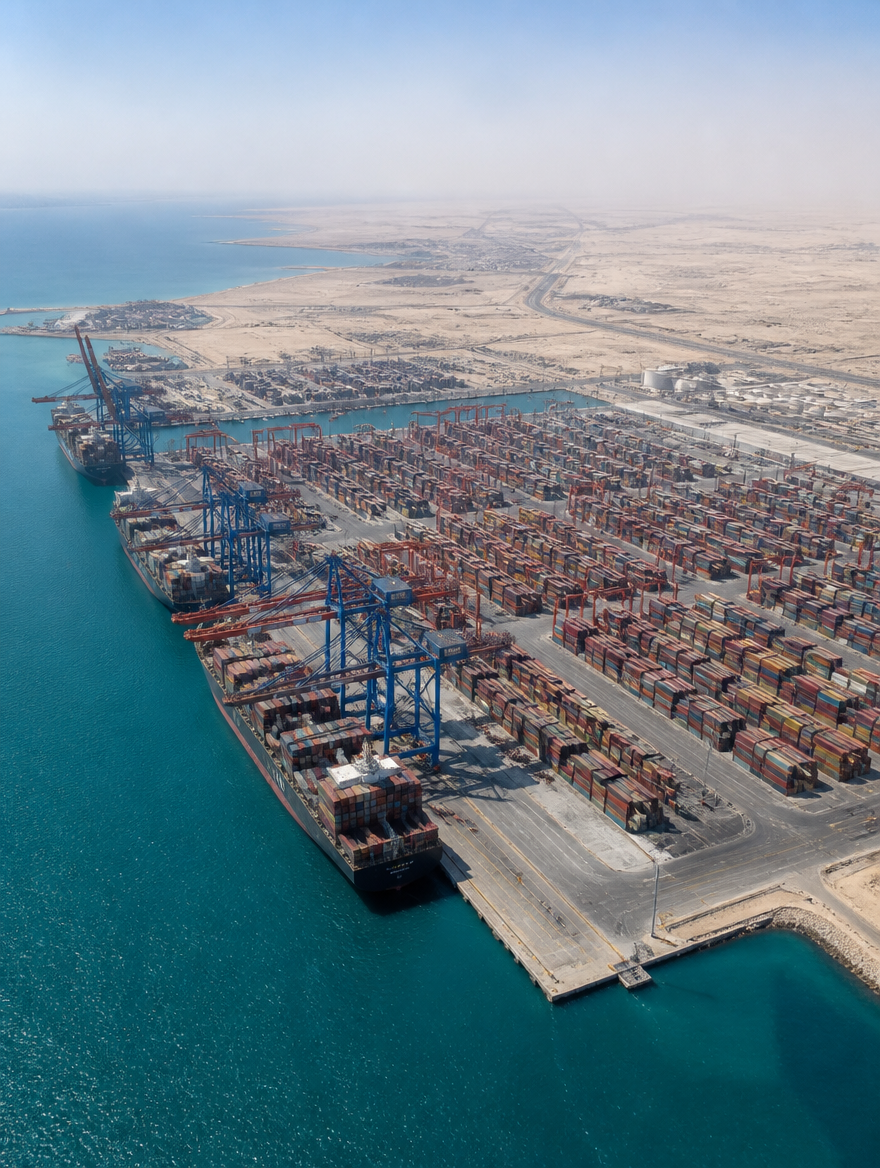
Look closely at shipping routes out of Shanghai and Shenzhen and you'll notice something odd: a huge share of containers headed for Africa, Eastern Europe and parts of South Asia doesn't travel there directly — it passes through one port first: Jebel Ali in Dubai. It's the largest man-made harbor in the world and, not coincidentally, one of the busiest transshipment hubs on the planet.
A port built for transfer, not final consumption
Jebel Ali isn't a typical destination port where a container gets unloaded and trucked to a local warehouse. Its whole purpose is repackaging. A vessel arrives from China with a large consolidated shipment; cargo is sorted, part of it stays in the Jafza free zone, and the rest is loaded onto smaller ships or trucks bound for Mombasa, Karachi, Jeddah or Odesa. Terminals run by operator DP World handle container throughput in the tens of millions of TEU annually, keeping the port consistently in the world's top ten by volume.
Jafza: a free zone older than the modern skyline around it
The Jebel Ali Free Zone (Jafza), founded back in 1985, today hosts over 9,500 companies — from global logistics operators to small Chinese trading houses that keep consolidation warehouses here. The key advantage for a re-exporter is straightforward: zero customs duty inside the zone, 100% foreign ownership, and the ability to hold goods indefinitely while waiting for the right moment to ship onward.
Why route through the UAE instead of direct
Direct shipping from China to individual African or Central Asian countries is often slower and more expensive than routing through Dubai — fewer direct shipping lines, weaker port infrastructure at the final destination, more cumbersome customs processing. Jebel Ali solves this through sheer scale: hundreds of shipping lines call here, giving a trader the flexibility to switch cargo to the next available sailing without downtime.
According to regional trade bodies, the UAE's non-oil re-export trade — in which goods of Chinese origin make up one of the largest shares — runs into the tens of billions of dollars a year, and Dubai remains the region's largest trading hub by re-export volume.
What it means for businesses eyeing Africa and South Asia via China
For companies sourcing in China but selling into third markets, the Jebel Ali model is a ready-made template: consolidating in Dubai removes the need to maintain direct contracts with a dozen smaller destination ports. It's also a convenient base to operate from — a Jafza office comes with access to the UAE banking system, visa residency status, and world-class logistics infrastructure in one package.
Of course, the model has a flip side: an extra link in the chain means extra storage and handling costs, and re-export through Dubai isn't automatically cheaper than a direct shipment for every product category.
Infrastructure beyond the port itself
Jebel Ali isn't just berths and cranes. A whole ecosystem has been built around it: DP World's logistics park with millions of square meters of warehouse space, specialized cold-chain zones (important for pharmaceuticals and food), a terminal for general and bulk cargo, and, more recently, growing e-commerce capacity handling small international parcels for re-export through local postal and courier networks. It's this layering that sets Jebel Ali apart from ports that only know how to handle classic container flows.
Dubai as an alternative to Singapore, not a replacement
Logistics companies often compare Jebel Ali to Singapore — both ports thrive on transit rather than their own manufacturing or consumption base. But the UAE has a structural edge for African and Middle Eastern routes specifically: geographic proximity and time zones convenient for working with both Asian and European partners within a single business day. For a trader that means shorter transit times to end markets in East Africa and the Arabian Peninsula compared with routing through Southeast Asia.
For anyone who wants to see Jebel Ali's port and Jafza's logistics infrastructure firsthand rather than through a DP World brochure, business tours in the UAE are worth a look — routes built around actual warehouses and customs zones, not just offices on the top floors of skyscrapers.